You Know Me Always a Giver
You're at tiffin with a friend who's looking for a new job. They tell you they're interested in a company where your higher friend works. Y'all haven't spoken to your friend in a few years. What would you do?
1. Tell your friend you'll make the introduction
2. Tell your friend you'll make the introduction, and then ask them for assistance on your own issue
3. Tell your friend you don't feel comfortable making the introduction since yous're no longer in touch with your college friend
It turns out your answer to this question reflects your 'reciprocity style,' which is the fashion you approach interactions with others. According to Adam Grant, writer of Requite and Take, there are three dissimilar types of reciprocity types: givers, takers, and matchers.
Givers, takers, and matchers
What's the departure between these types?
Takers are self-focused and put their ain interests ahead of others' needs. They endeavour to proceeds as much as possible from their interactions while contributing equally little every bit they can in render.
Matchers similar to preserve an equal balance of giving and taking. Their mindset is: "If you have from me, I'll accept from you. If you give to me, I'll give to you."
Givers are others-focused, and tend to provide back up to others with no strings attached. They ask themselves, "How can I add value for this person? What can I contribute?"
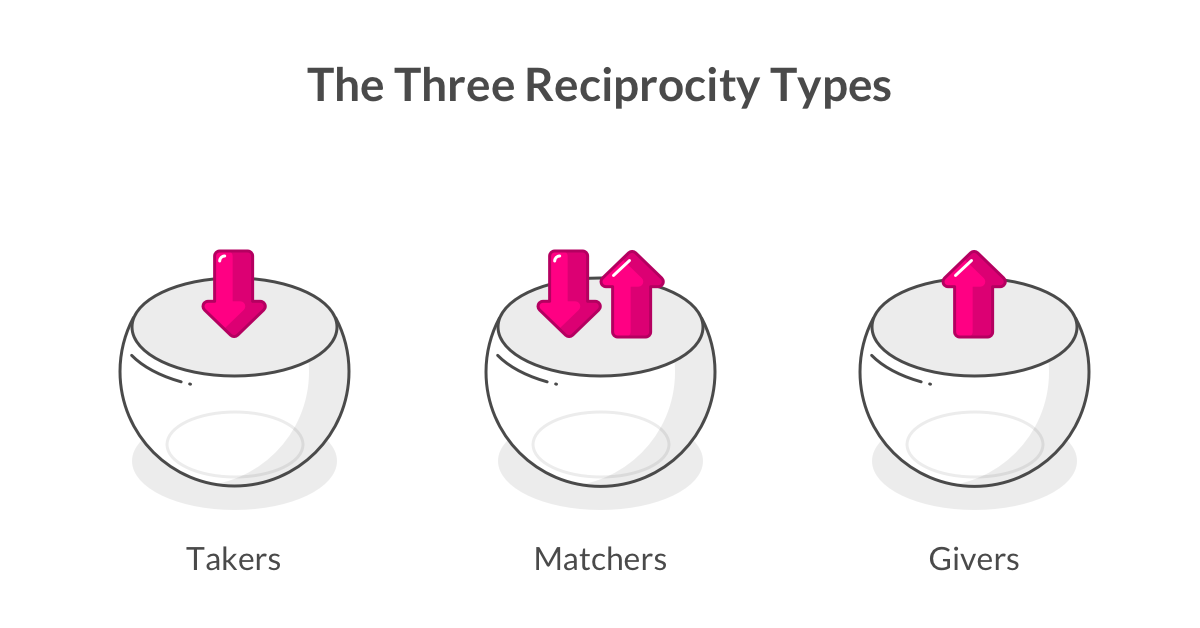
So what blazon are y'all? Turns out about people hover in the middle, and behave as matchers, answering option B to a higher place (I'll introduce you to my college friend, but I need help from you).
Humans have an innate tendency to be reciprocal, and givers and takers represent two extremes.
Simply while givers are the virtually generous in our society, matchers play an important office. They make sure what goes effectually, comes around. They reward givers for their generous behavior, and seek revenge when they, or others, are beingness mistreated.
Givers, takers, and matchers at work
Estimate which of these types is the almost successful at work.
Turns out, givers tend to be the worst performers. They're at a disadvantage across a broad range of occupations, because they sacrifice their own success to help others succeed, according to Grant's research.
So that must mean takers or matchers are the tiptop performers, correct? Not exactly.
Information technology's the givers again.
Yeah, you read right. The worst and best performers at piece of work are others-focused, and takers and matchers tend to country in the middle.
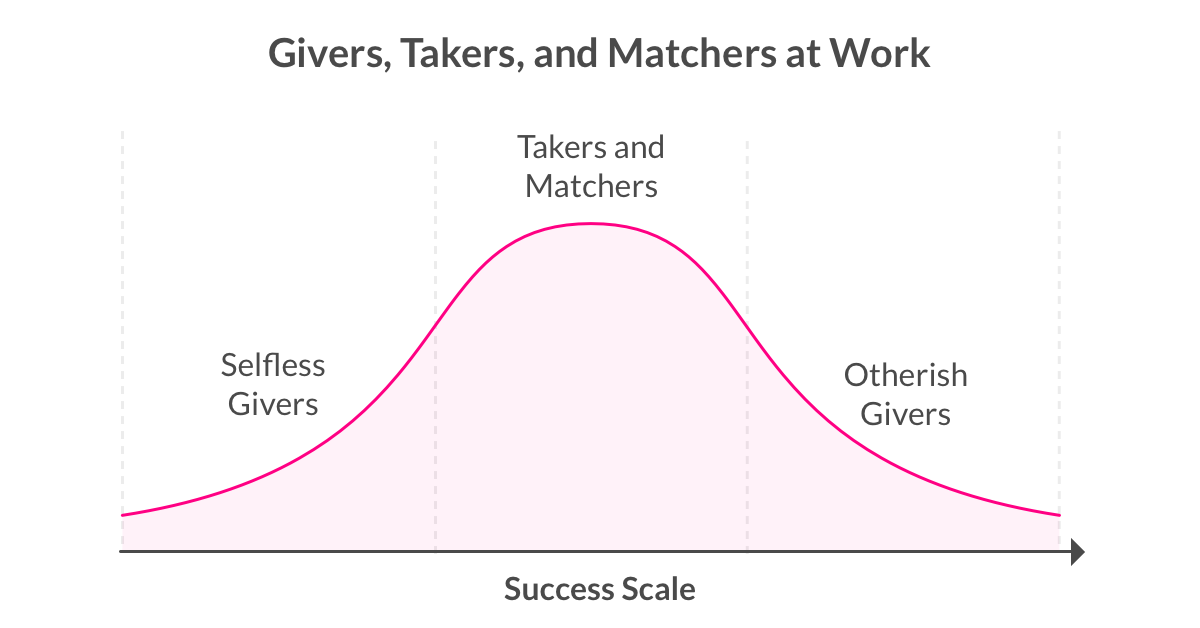
Why is that? Since takers develop reputations for putting others last, matchers tend to return the favor and try to knock them down, research shows. That's why takers rarely succeed in building strong relationships and networks.
On the other hand, matchers root for givers to succeed, since they tend to friction match good act with adept act. Anybody loves, trusts, and supports givers, since they add value to others and enrich the success of the people around them.
In short, givers succeed considering their giving leads to quality relationships, which benefit them in the long run. With such strong relationships, it's no wonder givers are also happier people than takers.
Merely wait, back upward. If beingness a giver creates stronger relationships (and even makes you happier), why are some givers at the lesser of the success ladder, while others are at the superlative?
Selfless givers vs. otherish givers
In that location are two types of givers: 'selfless' givers and 'otherish' givers.
Selfless givers, every bit you may guess, are the ones who drop everything to help people all the fourth dimension, which ways they tend to fall backside on their own work. Therefore, they usually end up at the bottom of the success ladder (though they're still happier people than takers).
On the other paw, otherish givers are smart and strategic well-nigh their giving. While they're just equally much givers as the selfless givers, they've learned to successfully navigate a world with matchers and takers, so others don't take advantage of them.
At this indicate, you must be asking: what steps tin I take to become a successful giver? After all, beingness a successful giver comes with many perks: stronger relationships, increased happiness, and better operation at piece of work.
Well, we're glad you asked. Here are a few tricks and tools successful givers have up their sleeves to help others while avoiding exhaustion.
How to be a successful giver
1. 5-minute favors
What to practise:
Do other people minor favors that take no more five minutes – similar making an introduction, giving feedback, and offering advice.
Why it works:
Made famous by series entrepreneur Adam Rifkin, five-minute favors are those pocket-sized yet impactful favors you do for others that take no more than than 5 minutes. Doing these quick favors for a coworker or friend can become a long way in strengthening your relationships.
two. Ask for help
What to practise:
Ask a friend or coworker for help on an issue yous're having, without taking upwards too much of their time.
Why it works:
While request for help doesn't sound like a quintessential giver move, doing so comes with some surprising benefits. Information technology gives them the opportunity to exist a giver, only too makes them experience good and smart.
According to Grant, one of the best ways to build strong relationships is to seek advice, because it creates meaningful opportunities for someone to contribute to your life, and feel fulfilled past it.
3. Requite all at once
What to do:
Devote a item solar day or function of a 24-hour interval each week to helping people out.
Why it works:
There are ii ways to give: yous can sprinkle random acts of kindness throughout your week, or chunk all of your giving acts into i day. Which is most effective? The chunking, research shows, because it leaves y'all with a bigger psychological boost of feeling appreciation and meaningfulness, which will motivate you to go on being a giver.
four. Specialize in favors
What to do:
Pick one or two ways of helping that y'all bask and excel at, rather than beingness jacks of all trades.
Why information technology works:
This manner, you can help in a way that energizes you instead, of exhausts you. This trick will as well allow yous to gain a reputation as a person with a particular expertise you lot're willing to share, rather than as a prissy person who'south freely available.
Bonus? People won't come to yous for favors that don't fit these skills.
5. Keep an eye out for takers
What to do:
Spot takers early, based on reputation and by experience, and simply assist them if they similar you.
Why it works:
Takers like to milk givers for favors, because of givers' reputations. To avoid this, take on the mentality of a matcher. In other words, if a taker asks for assist, say "sure, I'll assist you if you agree to help me with something else in return."
Give, give, give!
Exercise these tips and tricks, and you'll be a successful giver in no fourth dimension. But the key to being a successful giver is also existence an accurate giver. The less y'all try to give to get, the more you'll succeed.
Check out the next article in our Givers, Takers, Matchers series, where we explore how these reciprocity styles affect non just individuals, merely also industries.
– – –
Are you a giver, taker, or matcher?
Here are a few more questions from Adam Grant's Give and Accept quiz to help yous find out.
1. You and a stranger will both receive some money. Yous have 3 choices about what you and the stranger receive, and you'll never see or meet the stranger. Which option would y'all choose?
a) I get $8, and the stranger gets $4
b) I get $5, and the stranger gets $7
c) I go $5, and the stranger gets $5
2. In 2006, after the devastation caused past Hurricane Katrina, a U.s. banking concern executive led a team of employees on a trip to assistance rebuild New Orleans. Why do you think he did this?
a) He wanted to make headlines for existence a generous, giving organization
b) He felt compassion for the victims and wanted to exercise whatever he could to help
c) He wanted to show his support for depository financial institution employees who had family members in New Orleans
3. You're applying for a job as a manager, and a former dominate writes you lot a glowing recommendation alphabetic character. What would you be most likely to do?
a) Go out of my way to brand a skillful impression on my new boss, so I can line up some other strong recommendation for the time to come
b) Offer to write a recommendation letter for one of my ain erstwhile employees, so I can pay information technology forward
c) Expect for ways to help my quondam boss, so I tin can pay it back
4. You're working on a project with 2 colleagues, and there are 3 tasks that need to become done. Every bit you discuss how to divide tasks, it becomes clear that all 3 of you are extremely interested in two of the tasks, but view the third equally quite tedious. What would you practice?
a) Endeavour to convince one of my colleagues to do the boring task
b) Volunteer for the boring task without asking for anything in render
c) Volunteer for the tedious chore and ask my colleagues for a favor afterwards
v. A few years ago, you helped an acquaintance named Jamie detect a job. You've been out of touch since and so. Suddenly, Jamie sends an email introducing y'all to a potential concern partner. What's the nigh likely motivation backside Jamie'due south electronic mail?
a) Jamie wants to ask for help once more
b) Jamie genuinely wants to help me
c) Jamie wants to pay me back
If you answered generally A's, you're a taker. If y'all answered mostly B's, yous're a giver. If you answered mostly C's, you're a matcher. 🙂
thomasgoodditin81.blogspot.com
Source: https://www.lemonade.com/blog/psychology-givers-takers-matchers-2/
0 Response to "You Know Me Always a Giver"
Enregistrer un commentaire